Volvo Trucks

Volvo Trucks has a very large base of customers, each with different needs, motivations and risks. Their website needed to speak to all of them
At 10kR, I worked with Volvo team to design an AI system that used synthetic personas that speaks to each buyer for user testing and copy writing.
What I did
AI Strategy
AI Testing
UX Design
Design Systems
DURATION
3 months
I built an AI -powered system that mirrors real buyer behavior. So with 5 different kinds of buyers that Volvo has, my AI conducted automated user tests for first testing the content, structure, experience, and then after implementing the results in designs, retesting it with the personas, to land on the most optimal expereince.
Final Designs

Impact on the users and product
Best Capstone Display in show!!
Increased average time from 1 min to 4 mins per session in early testing
CSAT score of 4.6 reflecting high initial satisfaction
Improving task completion time by 60% through optimized user flows

"It actually felt fun to explore music with others — like hanging out, not just using an app"
Imapct
I built the system around 3 things - inputs, engine and the experience
I broke the system into 3 connected layers
Input is what the system knows
The product knowledge, customer perspectives, business context, and constraints the system needs to understand before it can make a useful evaluation.
Engine is how the system thinks
The reasoning, evaluation criteria, and rules that shape how the system interprets that context and turns it into consistent decisions.
Experience is what the team gets back
The structure and format that turns the system’s reasoning into clear, comparable, and actionable insights the team can actually use.
Imapct
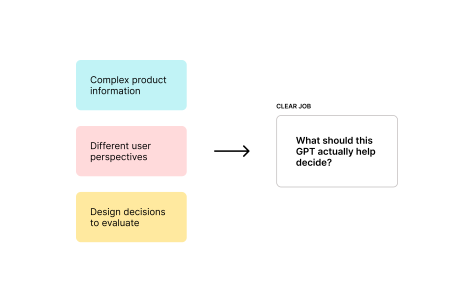
A strong system starts with a clear job
Before deciding what the system needed to know, I defined what I wanted it to help us do: evaluate Volvo’s digital experiences through the perspective of real customer groups and turn those evaluations into insights the design team could actually use.
Imapct
We need context for the system, but more context isn't always better
The goal wasn’t to give the system everything we had. I focused on the information that would actually influence an evaluation — Volvo’s product knowledge, customer perspectives and business context — while setting clear boundaries around what it could and couldn’t use.
01
Product
Features, capabilities, approved information
02
Users
Personas,needs,priorities, behaviours
03
Business
What matters to Volvo and the team
04
Boundaries
What it should not assume, invent, or include
Imapct
The next challenge is making all the context and story work together
The real challenge was making all that context work together.
Giving the system the right information was only the starting point. The harder part was defining how it should use that information when evaluating an experience — which signals mattered, how different customer perspectives should influence the evaluation, and how to keep that thinking consistent from one test to another.
I built a structured reasoning layer that brought those pieces together. The system could evaluate the same experience through different customer perspectives, apply a consistent set of criteria, and turn what it found into scores, themes, issues, and recommendations that could be compared across tests.
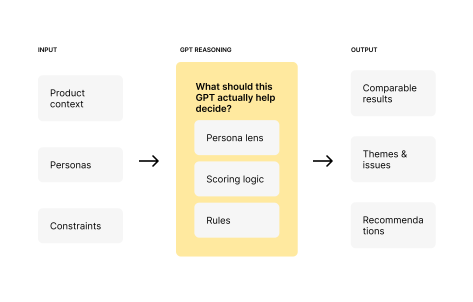
The goal wasn’t to tell the system exactly what conclusion to reach. It was to give it a consistent way to get there.
Imapct
The real test was seeing where the system fell apart
I tested the system across different scenarios and looked for patterns in where the responses became generic, inconsistent or unsupported. Instead of fixing individual answers, I traced those problems back to the system and adjusted the context, rules or output structure before testing again.
TEST
Use design screens, personas and evaluation tasks
SPOT
Generic output, inconsistency, unsupported reasoning
REFINE
Tune context, logic, constraints, or output structure
TAKEAWAY